
Dew point vs relative humidity: which one should you watch?
Relative humidity swings all day while the dew point barely moves. Here's what each number tells you and when to use it.
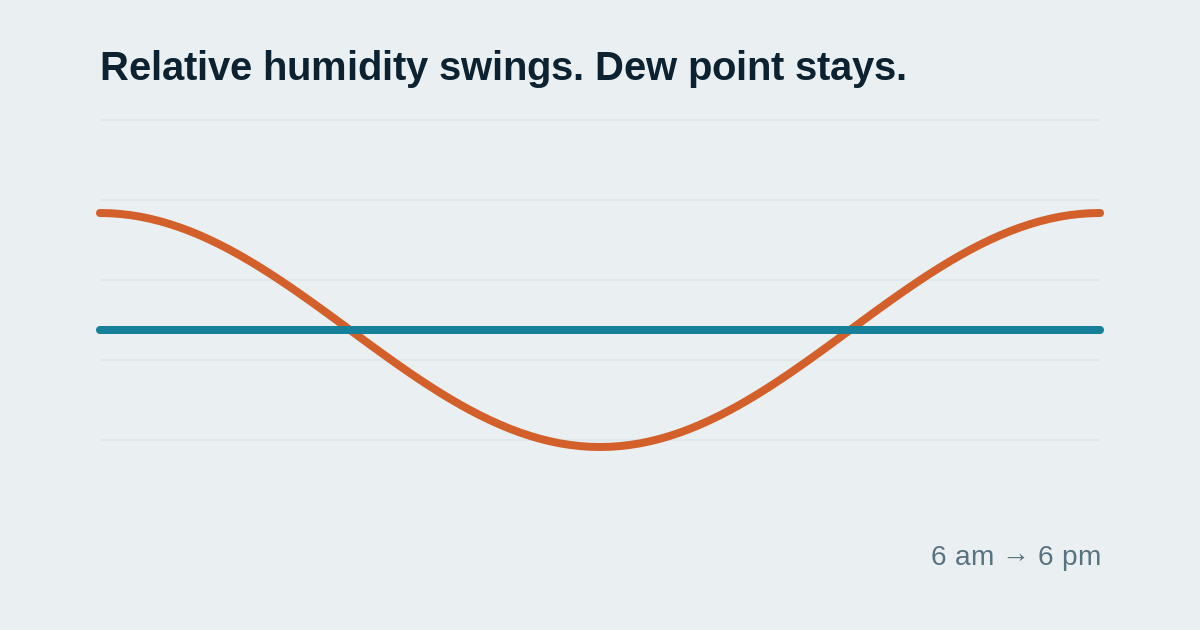
Relative humidity is the number most weather apps lead with. But it changes every hour, even when the air itself hasn’t changed at all. The dew point doesn’t.
Same air, two very different humidity readings
Take a summer day with a dew point of 15 °C. The moisture in the air stays the same from dawn to dusk:
| Time | Air temperature | Dew point | Relative humidity |
|---|---|---|---|
| 6 am | 16 °C | 15 °C | 94% |
| 10 am | 22 °C | 15 °C | 64% |
| 3 pm | 28 °C | 15 °C | 45% |
The relative humidity fell by half. Nothing about the water in the air changed. Warm air simply has more room for vapour, so the same amount fills a smaller share of it.
Rule of thumb: relative humidity tells you how close the air is to saturation. Dew point tells you how much water is actually there.
When to use the dew point
- Comfort. Above about 18 °C (65 °F) dew point, most people feel sticky, whatever the humidity reading says.
- Fog and frost. When the evening temperature drops close to the dew point, fog or dew is likely by morning.
- Condensation. Any surface colder than the dew point gets wet: windows, cold-water pipes, the inside of a wall.
When relative humidity is the better number
- Mold and storage. Mold growth and wood moisture depend on the humidity right at the surface, so RH is the guide indoors.
- Drying. Paint, plaster and laundry dry faster at low RH.
Try it
Open the dew point calculator, set Solve for to Humidity, fix the dew point at 15 °C and change the air temperature. Watch RH move while the dew point stays put.